Welcome to the Mathematical World!
Li Shanlan
Mathematical Translator and Innovator of Qing Dynasty China
Li Shanlan (1810–1882) was a Chinese mathematician and translator during the Qing Dynasty who played a crucial role in introducing Western mathematical knowledge into China. Originally trained in traditional Chinese mathematics, Li gained recognition for his exceptional skills in algebra and series expansions. His career took a major turn when he collaborated with British missionaries such as Alexander Wylie to translate modern Western works on algebra, geometry, and calculus into Chinese.
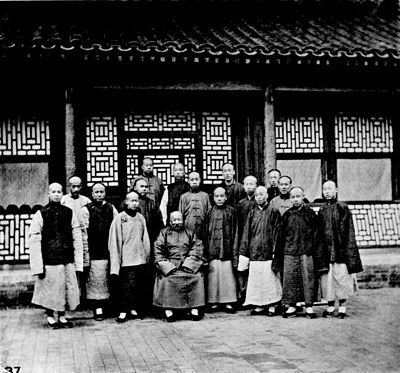
Li’s contributions included the introduction of algebraic notation and the translation of differential and integral calculus. For example, he worked on problems involving infinite series, using symbolic methods to represent expansions such as: \ This notation was revolutionary for Chinese mathematics, which traditionally relied on rhetorical descriptions rather than symbolic formulas. By adapting Western symbols into a Chinese context, Li facilitated the modernization of mathematical education in China.
Beyond translation, Li contributed original work on algebraic methods, including the study of polynomial equations and properties of sequences. He wrote extensively on practical mathematics as well, producing treatises on land surveying, calendrical calculations, and astronomy. His dual role as both an innovator and translator made him instrumental in bridging Chinese traditions with modern global science.
Li Shanlan’s legacy lies in his ability to integrate foreign mathematical systems into Chinese scholarly culture. His translations and writings became foundational texts for generations of Chinese students, and he is celebrated today as a key figure in China’s scientific modernization of the 19th century.

All rights reserved by the Mathematical Unity
Contact: +8801400044645
Email: mathematicalhorse1453@gmail.com
Our Discord Server: Mathematical Unity [Ulus Riyadiyat]